

Technical & Process Risk Management Services in Nigeria
Protecting people, assets, and your licence to operate — through structured, internationally aligned risk management frameworks. Andolf Energy Services Limited is Nigeria’s trusted partner for PSM, AIM, Enterprise Risk, and community risk communication.
Risk is inherent in every oil & gas operation, industrial facility, and infrastructure project. But risk is not inevitable harm — properly managed, it is a solvable challenge. Andolf Energy’s Technical & Process Risk Management division brings the systems, expertise, and discipline to identify, quantify, control, and communicate risk across your entire operation.
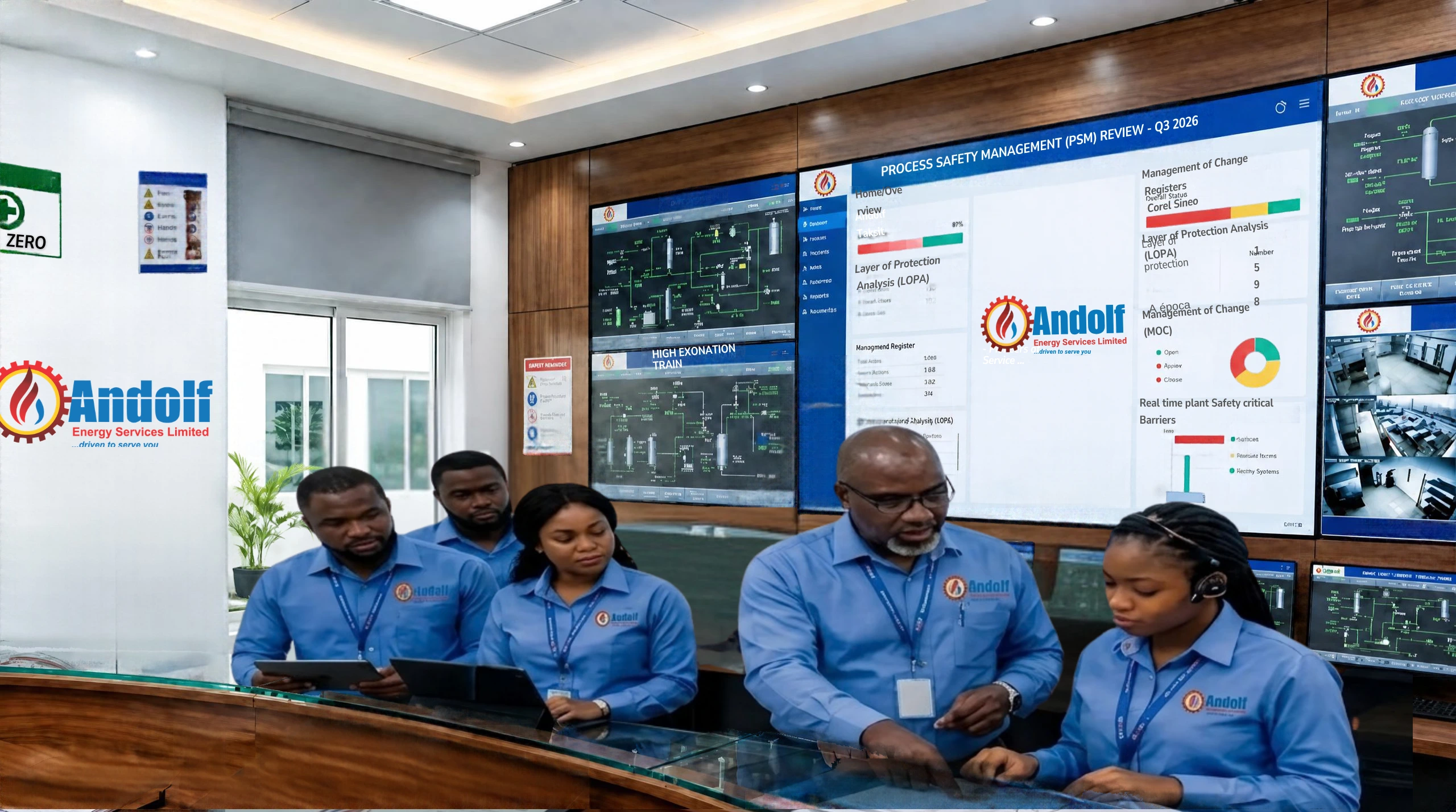
F. Process Safety Management (PSM)
What is Process Safety Management?
Process Safety Management (PSM) is a systematic, OSHA-defined framework for identifying, evaluating, and controlling hazards in facilities that handle, process, or store highly hazardous chemicals and materials. An effective PSM programme is not just a regulatory obligation — it is the difference between a safe, productive facility and a catastrophic incident.
Andolf Energy has a structured strategy for identifying and combating hazards, alleviating risks, and ensuring compliance in industries handling hazardous materials and complex processes. Our PSM framework is built on all 14 critical OSHA PSM elements:
The 14 Elements of Our PSM Framework
- Process Safety Information (PSI) — Maintaining comprehensive, accurate
documentation on hazardous materials, process technology, and equipment - Process Hazard Analysis (PHA) — Systematic, team-based evaluation of process
risks using HAZOP, HAZID, LOPA, and other methodologies - Operating Procedures — Clear, written procedures for all phases of operation
including startup, shutdown, emergency, and abnormal operations - Employee Training — Structured, competency-based training on operating
procedures, hazards, and emergency response - Contractors’ Safety Management — Pre-qualification, orientation, and oversight of
contractors working in process areas - MechanicalIntegrity — Inspection, testing, and maintenance of process equipment
to prevent failures that could lead to releases - Management of Change (MOC) — Formal review and approval of all changes to
process, equipment, procedures, or personnel before implementation - Pre-Startup Safety Review (PSSR) — Verification that all safety, operating,
maintenance, and emergency requirements are met before new or modified facilities
start up - Emergency Planning and Response — Development, testing, and maintenance of
emergency response plans and capabilities - Incident Investigation — Thorough investigation of incidents and near-misses to identify root causes and implement preventive actions
- Compliance Audits — Periodic, systematic review of PSM programme effectiveness and regulatory compliance
- Trade Secrets Protection — Ensuring PSM programme information is protected in accordance with applicable regulations while remaining accessible to those who need it
- Employee Participation — Active involvement of employees at all levels in PSM programme development and implementation
- Safety Culture and Leadership Commitment — Visible, consistent leadership commitment to process safety at every level of the organisation
G. Asset Integrity Management (AIM)
Protecting Your Most Valuable Assets
Asset Integrity Management (AIM) is the systematic approach to ensuring that critical assets, pipelines, vessels, structures, rotating equipment, perform their required function safely and effectively throughout their lifecycle. Andolf Energy’s AIM services help clients establish a true integrity culture.
Our AIM services include:
- Failure Investigation Studies — Root cause analysis of asset failures to prevent recurrence and improve reliability
- Risk-Based Inspection (RBI) — Prioritising inspection resources based on the likelihood and consequence of failure, focusing effort where it matters most
- Fitness-for-Service Reviews — Engineering assessments to determine whether an asset with known damage or degradation is safe to continue operating
- Condition and Structural Health Monitoring (CSM) — Continuous or periodic monitoring of asset condition to detect degradation early
- Life Extension Studies — Engineering evaluations to support decisions about extending the operating life of assets beyond their original design life
- Procedure Implementation and Compliance — Ensuring that documented integrity procedures are actually implemented and maintained in the field
Effective AIM reduces unplanned downtime, extends asset life, optimises maintenance spend, and prevents incidents, delivering real, measurable value to your operation.
H. Enterprise Risk Management (ERM)
Organisation-Wide Risk Governance
Beyond process and asset risks, organisations in Nigeria’s energy sector face a broad spectrum of enterprise-level risks. Andolf Energy’s Enterprise Risk Management services provide a structured framework for identifying, assessing, controlling, and monitoring risks across the full business:
- Risk Identification — Systematic identification of risks across operational, financial, regulatory, reputational, and strategic dimensions
- Risk Analysis — Qualitative and quantitative assessment of likelihood and impact
- Risk Evaluation — Prioritisation and ranking of risks to focus management attention
- Risk Controls & Mitigation — Development and implementation of cost-effective risk controls
- Risk Monitoring — Ongoing tracking of risk indicators and control effectiveness
- Risk Reporting & Communication — Clear, structured reporting to management, boards, and regulators
- Governance & Culture — Embedding risk awareness and accountability into organisational culture
- Compliance & Legal Risk Management — Identifying and managing regulatory, contractual, and legal risk exposures
I. Risk Communication, Community Engagement & Operationalisation
Protecting Communities. Building Trust. Enabling Operations.
In Nigeria’s operating environment, effective community engagement and risk communication are not optional, they are fundamental to maintaining the social licence to operate and ensuring communities near industrial operations are safe and informed.
Andolf Energy’s Risk Communication services include:
- Detecting, Assessing & Notifying — Identifying public health risks and environmental events and establishing timely, accurate reporting mechanisms
- Effective Risk Communication Mechanisms — Designing and establishing communication systems that ensure vital, life-saving information reaches affected
communities at the right time in the right language - Technical Support for Operations — Monitoring the functionality of implemented risk communication and community engagement systems
- Strategy Development & Implementation — Developing and implementing plans that promote positive safety behaviours and build trust between operators and host communities
Frequently Asked Questions
What is Process Safety Management (PSM) and why is it important in Nigeria's oil & gas sector?
Process Safety Management (PSM) is an OSHA-mandated, 14-element framework for managing hazards in facilities handling hazardous materials. In Nigeria’s oil & gas sector, PSM is critical for preventing major incidents, ensuring regulatory compliance with NUPRC standards, protecting workers and communities, and maintaining production uptime. Andolf Energy provides full PSM implementation, auditing, and training services.
What is Asset Integrity Management (AIM) in oil & gas?
Asset Integrity Management (AIM) is the systematic process of ensuring that oil & gas assets — pipelines, vessels, structures, and equipment — safely and reliably perform their intended function throughout their lifecycle. It encompasses risk-based inspection, fitness-for-service assessments, structural health monitoring, and life extension studies.
Does Andolf Energy provide HAZOP services in Nigeria?
Yes. Process Hazard Analysis (PHA), including HAZOP (Hazard and Operability Study), HAZID, and LOPA (Layer of Protection Analysis), is a core part of our Process Safety Management offering. We have delivered HAZOP and SAFOP services for the Ondo State Government’s Independent Power Project.
How does risk-based inspection (RBI) help reduce costs?
RBI prioritises inspection resources based on the probability and consequence of failure, rather than fixed time intervals. This means you spend inspection budget where it matters most — reducing unnecessary inspections on low-risk items while ensuring high-risk assets receive appropriate attention. Well-implemented RBI typically reduces inspection costs while improving risk coverage.
Can Andolf Energy help with community engagement for oil & gas projects in Nigeria?
Yes. We provide Risk Communication, Community Engagement and Operationalisation services specifically designed for Nigeria’s operating context — helpingb operators communicate risks clearly, engage communities proactively, and maintain the social licence to operate.
